Daily AI Newsbites
AI関連の最新ニュースをピックアップ
← 2026年10月12日(月)のニュース一覧へ引用元:Sakana AI 

Sakana AI、再帰的自己改善技術「MASS」を発表
Sakana AI
研究
AIエージェント
オープンソース

東京を拠点とするAIスタートアップのSakana AI(自然界の創発現象を模倣するAI研究を行う東京拠点のスタートアップ)は、米カリフォルニア大学バークレー校(UC Berkeley)の研究者らと共同で、マルチエージェント自己監督による再帰的自己改善技術「MASS(Multi-Agent Self-Supervision。複数エージェントの協調軌跡から単一モデルを自己改善する技術)(Multi-Agent Self-Supervision)」を発表した。
人間による正解ラベルやルールベースの自動検証が得られない高度な研究課題において、モデル自身が自律的に学習ループを回して性能を向上させる新たな枠組みを提示している。関連論文(arXiv:2610.12176)および実装コード(GitHub)も同時に公開された。
単一モデルが3役を兼ねる同質的RSI
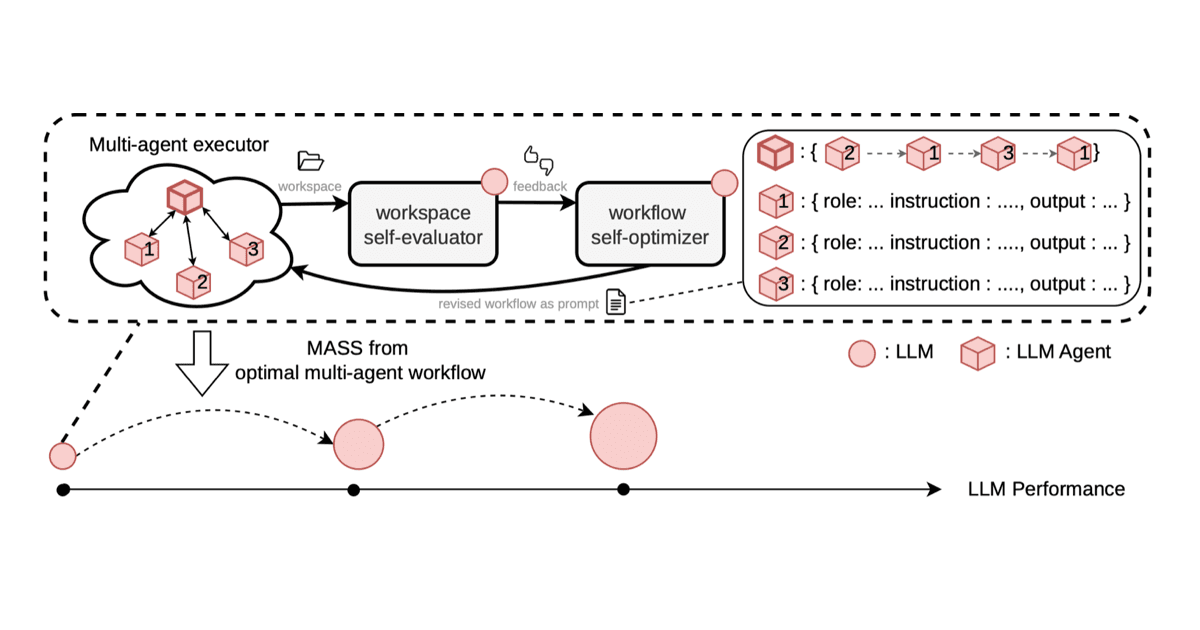
MASSの中核は、同一の重みを持つ単一の言語モデルが「タスク実行者(Agent/Optimizee)」「ワークフロー最適化者(Optimizer)」「評価者(Evaluator)」の3役を兼任する同質的再帰的自己改善(homogeneous Recursive Self-Improvement: RSI)にある。
- インナーループ(ワークフロー最適化): モデルの重みを固定したまま、サブエージェント間の役割分担・指示・入出力規約・実行順序(ホップ)からなる協調ワークフローを探索。自己評価に基づいて最適なワークフローを選定する。
- アウターループ(モデル重みの更新): 最良と判定されたチームの協調軌跡(実行ログ)をもとに、基盤モデルを教師あり学習またはファインチューニングによって更新。チームの集合的経験をモデルへ蒸留する。
- ループの反復: 更新されたモデルが再び3役を担当し、次のサイクルへと進む。
27B(270億パラメータ)のオープンウェイトモデルを用いた実験では、合成されたオープンエンドな研究タスクにおいて2サイクルの自己改善を実施した結果、4つの研究ベンチマークで出力トークンあたりのスコアがベースモデル比で1.2倍〜1.6倍に向上した。
本研究から得られた3つの重要知見
論文では、マルチエージェント協調を用いた自己改善に関して3つの重要な性質が報告されている。
- 役割の汎化(Role Generalization): タスク解決の実行データのみで訓練した場合でも、タスク実行能力だけでなく、ワークフロー最適化能力および自己評価能力の双方が自然に向上する。
- マルチエージェント軌跡の学習効率: 単一エージェントによる試行錯誤のログに比べ、役割分担されたチームの協調軌跡の方が、RSIの訓練データとして高い改善効率を発揮する。
- 改善速度のボトルネック: 自己改善サイクルの速度を制約するボトルネックは評価者の能力ではなく、新たなワークフローを構想・探索するオプティマイザの能力にある。
進捗の客観的検証にあたっては、MASSシステムには秘匿された外部フロンティアモデル(GPT-5.5およびClaude Opus 4.8)による二重盲検的な評価が実施され、モデルの自己評価と外部評価の双方向で着実な向上が確認された。
同質的自己改善に伴う安全性リスクと課題
Sakana AIの研究チームは、同質的RSIの可能性を示すと同時に、AI安全性の観点から慎重な検証の必要性を強調している。
同一モデルが評価者と実行者を兼ねる閉じたループでは、モデル固有の「盲点(blind spots)」が自己評価によって正しい進歩と誤認され、訓練を通じて偏見や誤りが固定化・強化されるリスクが存在する。人類の専門知識を超えるフロンティア領域でAIを安全に自律進化させるためには、こうした盲点の検出機構と適切な介入手段の確立が不可欠となる。
参考ソース
Recursive Self-Improvement through Collective Intelligence
Recursive Self-Improvement through Collective Intelligence
https://sakana.ai/mass
Sakana AI
Multi-Agent Self-Supervision (MASS)
Self-supervision through better coordination among agents that share one language model.
https://pub.sakana.ai/mass
arXiv.org
Recursive Self-Improvement through Multi-Agent Self-Supervision
Recursive self-improvement (RSI) of a model on non-verifiable tasks, such as open-ended research, faces a supervision bottleneck when its outputs exceed what even human experts can reliably assess, leaving the model itself (optimizee) as the best available optimizer and evaluator. However, a single model instance struggles to critique and improve its own complex reasoning under this homogeneous loop. To address this, we propose Multi-Agent Self-Supervision (MASS), an RSI method that alternates between evolutionary workflow optimization and supervised fine-tuning on self-generated trajectories. Guided by early findings that multi-agent topologies excel at complex reasoning, MASS prompts a single base model to iteratively propose, execute, and self-evaluate multi-agent workflows. Through an evolutionary search constrained by structural guardrails, the model optimizes these computational-graph-like orchestrations, discovering the most effective distinct roles and information routing for a given task. Over two MASS cycles with Qwen3.6-27B, the model achieves 1.2-1.6x higher performance per output tokens on four open-ended public benchmarks. Because the improved model subsequently acts as a better optimizer and evaluator, this alternating framework enables a continuous, recursive bootstrapping of the model's capabilities. Moreover, multi-agent traces are also more training-efficient: a student trained on them outperforms a single-agent student trained on 1.4x more training tokens. These findings suggest that jointly learning orchestration and bounded subagent execution from multi-agent trajectories can provide an effective signal for RSI.
https://arxiv.org/abs/2610.12176